1977
- Monday, January 24, 1977
22h00-23h00 - CTV (12)
NANA MOUSKOURI - AND I LOVE YOU SO
Concert recorded in Hamilton on September 17, 1974.
01- Amazing Grace
02- And I love you so
03- Voici le mois de may
04- Odos Oniron
05- Plaisir d’amour
06- The white rose of Athens
07- Milisse mou
08- The three bells
09- I dreamed you
10- Bridge over troubled water
11- Enas mythos
(repeat on Wednesday, August 10, 1977 - 21h00-22h00)
- Wednesday, February 16, 1977
20h00-20h30 - SRC (2)
DU TAC AU TAC
«L’AFFAIRE MOUSKOURI / LE KIDNAPPING DE DALIDA» (16th épisode)
(comedy by André Dubois)
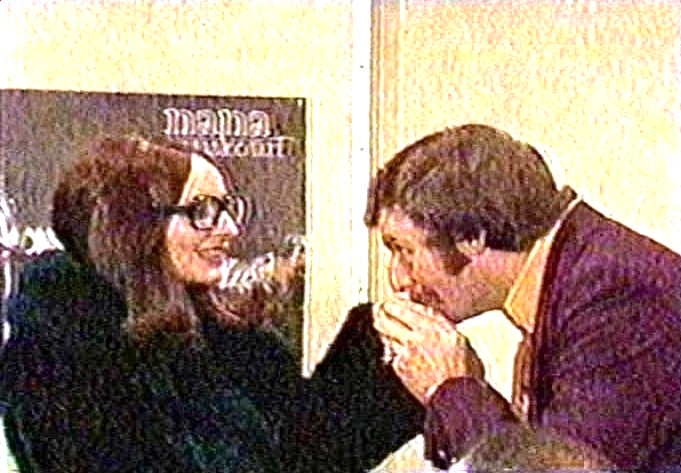
In order to play a trick on a journalist, Geneviève (France Castel) pretends to be Nana Mouskouri. When she disguises herself as Dalida, she is kidnapped. (1 m 08 s)
- Sunday, September 11, 1977
12h00-14h00 - TVA (10)
BON DIMANCHE
Review of Nana’s concert by Michel Girouard. (4 m 16 s)
- Sunday, September 18, 1977
12h00-14h00 - TVA (10)
BON DIMANCHE
(Pres.: Claude Mailhot)
It is necessary to prove many things so that the public returns home happy. When we sing in a language, we must understand it. Wherever she is, Nana sings in French. On stage, she doesn’t move a lot. The essential is to sing well and to move the audience. After the concert, she rests to be at her best the day after.
When her children were younger, they accompanied her on her tours. Now that they go to school, she organizes herself to spend much time with them.
She is enormously interested in politics. But Nana believes that she shouldn’t impose her opinions nor influence the public. She heard "Un Canadien errant" by an English Canadian singer. The theme touched her and she decided to include it in her song recital in spite of the opinion of her entourage.
She leaves again for France to make her return at the Olympia of Paris.
* LIVE (9 m 16 s)
- Monday, September 26, 1977
13h35-14h30 - SRC (2)
FEMME D’AUJOURD’HUI
(interview with Judith Paré)
Nana underlines the role of luck in her career. Her first experiences outside from Greece. The importance of the music from her childhood. Her studies in classical singing. The difficulties for a Greek woman to work. The organisation of the family life. Her disagreement with the current revolt of women.

(12 m 47 s)
|